
Showing posts with label 3D documentary. Show all posts

Thursday, August 9, 2012

Blu-ray 3D Review: Mars in 3D: Images from the Viking Mission


With all the buzz over Curiosity and its 3D images from the Martian surface, I found Mars in 3D: Images from the Viking Mission, produced by Elliott Levinthal of Stanford University (who passed away earlier this year), to be a great look into the first US mission to the red planet. Not only did we get 3D images from those Viking probes, but this half-hour documentary from 1978 presents these images and gives context to both the process of capturing them and their historical significance. Check out our video review of the Blu-ray 3D release:


As other reviews have noted, the 3D is extreme in parts. The stills of the Martian surface are presented with excessive negative parallax and no floating windows. Some were taken from orbit using images from multiple orbits, resulting in different shadows in the left/right images. The narrator takes the time to explain that the images were taken by two cameras 0.8 meters across and walks the audience through how to try and fuse the hyperstereo images. This is one of the few releases where I will say "bad 3D" is acceptable, because it preserves these historic images as they were originally shot, and undoubtedly influenced how 3D images were captured on later Mars missions. The footage of the narrator is presented in 2D, and footage of the Viking probe model in action are presented in 3D that is much easier on the eyes.
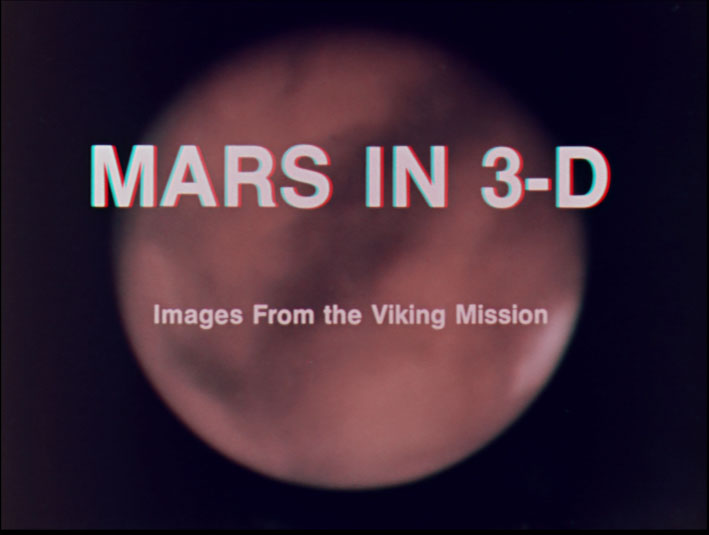

If it wasn't for the restoration efforts spearheaded by CCRMA and for AIX Records releasing this, Mars in 3D could very well have faded into history like so many other lost 3D films. The restoration from the original film print was impressive for an independent release, with few signs of dust and scratches, and no signs of jitter. In the 40-minute interview special feature, Michael McNabb explains the process by which they restored the left and right 16mm prints. The superb 5.1 mix was prepared from the original computer music. The film owes a lot to its soundtrack, whose ethereal and ominous tones emphasize the awe and suspense of being immersed in the landscape of an alien world. Without it, this would be a rather dull series of rocky photos.

The special features include:
Interview with John Chowning and Michael McNabb: a dry but enlightening 2D 40-minute interview about the history and restoration of Mars in 3D. The two are joined by Uri Geva, the Film Advisor and Editor, and William Schottstaedt, one of the composers.
About the Project: on-screen text providing historical context to the project
Mars Suite by Michael McNabb: an option to play just this composition
Mars Music by William Schottstaedt: an option to play just this composition

Overall I would recommend this if you liked Space Station 3D, and for any fan of space documentaries, space history, and the history of stereoscopic cinema. While the film is dry, I found it to be much more informative than most IMAX documentaries.

This can be purchased through AIX Records' website for $19.98. The entire film is also freely available on YouTube (minus the 5.1 sound and high quality MVC encode of the Blu-ray).

Sunday, December 4, 2011

NASA's 3D Video of Asteroid Vesta


NASA Jet Propulsion Laboratory California Institute of Technology released this 3D video (in anaglyph only) of Asteroid Vesta. From the press release:

The images were obtained when Dawn was making its approach to Vesta, and while orbiting the giant asteroid in its first science orbit, known as survey orbit, at an altitude of about 1,700 miles (2,700 kilometers). The video begins with a global view of Vesta from the plane of its equator, where a mysterious band of linear ridges and troughs can be seen. The movie cuts to a flyover of young craters in the northern hemisphere, whose peculiar alignment has led some scientists to refer to them as the "snowman." Then this virtual tour of Vesta takes the viewer around a massive mountain at the south pole of Vesta that is about 16 miles (25 kilometers) high, or more than twice the height of Mt. Everest.

"If you want to know what it's like to explore a new world like Vesta, this new video gives everyone a chance to see it for themselves," Jaumann said. "Scientists are poring over these images to learn more about how the craters, hills, grooves and troughs we see were created."

Vesta is the second most massive object in the asteroid belt between Mars and Jupiter. Dawn is currently spiraling down to its low altitude mapping orbit, which will bring the spacecraft to about 130 miles (210 kilometers) above Vesta's surface.

"Dawn's data thus far have revealed the rugged topography and complex textures of the surface of Vesta, as can be seen in this video," said Carol Raymond, deputy principal investigator at NASA's Jet Propulsion Laboratory, Pasadena, Calif. "Soon, we'll add other pieces of the puzzle such as the chemical composition, interior structure, and geologic age to be able to write the history of this remnant protoplanet and its place in the early solar system."

Dawn launched in September 2007 and arrived at Vesta on July 15, 2011. Following a year at Vesta, the spacecraft will depart in July 2012 for the dwarf planet Ceres, where it will arrive in 2015.

Dawn's mission to Vesta and Ceres is managed by JPL for NASA's Science Mission Directorate in Washington. JPL is a division of the California Institute of Technology in Pasadena. Dawn is a project of the directorate's Discovery Program, managed by NASA's Marshall Space Flight Center in Huntsville, Ala. UCLA is responsible for overall Dawn mission science. Orbital Sciences Corp. in Dulles, Va., designed and built the spacecraft. The German Aerospace Center, the Max Planck Institute for Solar System Research, the Italian Space Agency and the Italian National Astrophysical Institute are international partners on the mission team.

For more information about the Dawn mission, visit: http://www.nasa.gov/dawn
and http://dawn.jpl.nasa.gov .

To follow the mission on Twitter, visit: http://www.twitter.com/NASA_Dawn .

Monday, November 21, 2011

3D Documentary: Naked Bike Ride (NSFW)


Atomic Cheesecake Productions has released a short documentary on the Philadelphia Naked Bike Ride, part of the World Naked Bike Ride, a worldwide series of annual nude biking events. The motivations behind this are long and varied, but focus on cycling culture, environmentalism, and positive body image. The video is quite obviously NSFW for nudity.

Wednesday, February 16, 2011

3D Nazi films?! Not really...

Unrelated trench-hopping Nazis, courtesy of the Italian Stereoscopic Archive. 
It was revealed yesterday in Variety that two 3D short films produced by the Nazis have been conveniently-just-discovered.

In what could be described as a publicity stunt for Philippe Mora's upcoming documentary on how the Nazi regime used images to manipulate reality, the director has announced he unearthed two 3D shorts, produced for Goebbels' propaganda company. Except, both are described in Ray Zone's Stereoscopic Cinema and the Origins of 3-D Film, 1838-1952, which was published in 2007, and neither were produced for Goebbels. Despite what the headlines might lead you to believe, neither of these are a top-secret 3D Triumph of the Will with stereoscopic Hitlers marching out at you.

"So Real You Can Touch It" (Zum Griefen nah, aka Close Enough to Touch, aka You Can Nearly Touch It) premiered in Berlin in May 17, 1937, and was not shown in the US. It is a "short commercial film promoting insurance", according to Zone's book, and a musical set at a carnival featuring close-ups of a barbecue, according to Variety. How manipulative!

"Six Girls Roll into Weekend" (Sechs Madels rollen ins Wochenend), was a 12-minute promotional film produced by Zeiss Ikon in 1939, prior to the outbreak of the war. It was intended for internal use, never screened in the US, and the only public screening on record was in 1941 at a meeting of the German Society for Stereoscopy in Tobis-Haus, Berlin. Variety describes the content as "what may be UFA studio starlets living it up". Oooh, I can just sense the propaganda oozing out of this one.

Despite what the article implies, the Germans weren't the first producers of 3D films. Audioscopiks was a popular 3D featurette around the same time, other 3D shorts were produced sporadically in the 20's and 30's, and 3D photography dates back to the mid 1800's. 

Know any more about these films? Post a comment!


Monday, January 10, 2011

Blu-Ray 3D Review: IMAX Space Station 3D


*For those of you not familiar with Blu-Ray 3D, this is the new Blu-Ray spec for 3D content that can be watched on 3DTV's, or in 2D on regular Blu-Ray players. Our Blu-Ray 3D reviews will cover the film, the use of 3D, and the quality of the Blu-Ray itself*

IMAX Space Station 3D is a medium-length documentary from 2002, directed by Toni Myers, with narration by Tom Cruise. Having a life-long fascination with space-stuff, I was very excited to watch this in all its glory.